Will Your Family Business Survive to the Next Generation?
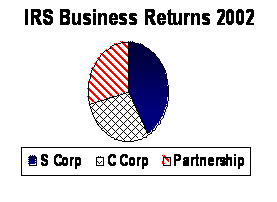 The wealth of theUnited Statesis often concentrated in family businesses, not the stock market, despite the occasional dire media warnings on slow news days. The IRS now reports that there are nearly a million more S corporation (more often used in smaller businesses) tax returns filed than regular corporate returns, and the gap continues to widen annually. Factor in the partnerships and sole proprietorships, and you find numerous entrepreneurs cranking out products and services that keep the economy rolling along. Unfortunately, few closely held or family businesses have done any succession or disaster planning. Vernon Rudolph, founder of the well-known Krispy Kreme doughnut franchise, died in 1973, but had no estate plan for his family. As a result, Krispy Kreme had to be sold and Beatrice Foods eventually acquired the company in 1976, and its family influence was lost. Even though Rudolph established his business inWinston-Salemin 1937, far from the stresses of big city concerns, he failed to create a plan that would preserve and protect his business interests for his family.
Why Do Family Businesses Fail?
Despite the posturing by politicians advocating tax relief and the elimination of the death tax, the reality is that by changing the rules and moving the goal posts so frequently, Congress has created a tax environment that results in taxpayer paralysis Estate planning should be a thoughtful process designed to work over many years, but a sense of impermanence and capriciousness in tax laws fosters inaction. While business owners acknowledge the risks of neglecting their transition problems, they doom their business to failure because they will not take the necessary steps to minimize the easiest tax to avoid with just a little planning. Even if there is no federal estate tax concern, there will still be taxes on income and capital gains, and newly imposed state inheritance taxes to deal with. However, the tax tail must not wag the dog. Once the tax issues are addressed, it may be more important to find a way to pass down a value system and maintain continuity. These are critical steps in the planning process, but too many advisors are not helping matters by ignoring the non-tax conflicts in their hurry to complete an estate plan and push their clients out the door with cookie cutter plans.
The estate planning process can be confusing and highly technical, contributing to the 66% of family business that fail to make it to the second generation. Try to pass the business on to the third generation and fewer than 14% make the grade. (Keeping the Family Business Healthy, John L. Ward, 1987). Among many of the other reasons for such high failure rates is the founder’s syndrome, or the inability to let go. For some owners with unhappy marriages, they have taken refuge in the business, while other owners dislike dealing with personally traumatic issues like mortality or disability. All of this contributes to a revolving door of quasi-retirement for the founder who has little else in life other than work, and who keeps showing up at the office without relinquishing control of the reins.
Many of the founders business interests are closely intertwined with their driven personalities. This determination to succeed is the foundation for their many achievements, and the source of future conflicts. Since control concerns are such a major part of their lifes work, acknowledging any loss of mental acuity or mortality is a real struggle. Additionally, many founders have made some bad decisions along the way and they worry about disrupting family relationships in the process of getting the situation back under control. How so? They may have ignored some family members by favoring just a few select heirs, or minimized the advice from non-family key employees. Too often, business founders put heirs on the payroll with no-show jobs or with limited responsibilities. By setting family members up in executive roles for which they have little training or aptitude, the founder creates unrealistic expectations for heirs. Add to the mix an heir who really works in the business and there will often be a festering sense of inequity where one heir is working and the other heirs are not; yet all draw a paycheck.
In the classic estate planning process, owners pass value down to heirs in the form of stock in corporations or partnership units in family entities. The problem is that owners will not voluntarily give up control of a business in which they have invested a good part of their lives, and such workaholics will not accept the concept of a life in retirement or the need for a family forum in which a fair and open exchange of information is necessary. For retirement to succeed, the energies and priorities of the founder have to be channeled into something other than work, but that is very hard when the founder fears becoming irrelevant and unappreciated by succeeding heirs.
Since the principals constantly interact with each other outside the business, family entities are often in turmoil because problems are brought home and the management stresses are not easily set aside. When children marry and have families of their own, the in-laws and third generation all want input. Getting all the players to focus on problems and achieve a unified management system is a lot like herding cats, not an easy situation under the best of circumstances. Besides conflicting goals, intergenerational conflict, and sibling rivalry, tension in the office is a foregone conclusion. Add to that volatile mix a history of poor communication and a failure to enact meaningful changes in management and frustration will build. Thus, it should be no surprise that few businesses maintain operations far beyond the founders life. In addition, it should shock no one that the founder may be the worst teacher for heirs as he tries to integrate them into the family businesshe has spent his life fixated on control, not on sharing information or techniques. Sometimes a non-family key employee or mentor can be a buffer and may be a better choice to interface between the generations to make sure everyone is prepared to assume his or her rightful place in the business.
Not all is lost. Some families manage to make the business work down through the years. The best example in theU.S.is the Zildjian Cymbal Co. of Norwell,Massachusetts Founded in 1623 by an alchemist named Avedis I in Constantinople, and relocated to the Quincy, MA in 1929, this family business holds the U.S. record for continuity. The founder discovered a metal alloy that created cymbals possessing special clarity. The business continues 14 generations later under the direction of two of his female heirs, Craigie and Debbie, after almost 400 years of continuous operation focused on supplying their niche product to musicians around the world.
The Plan
Generally, for a succession plan to work, the main concerns about death, disability and retirement must be addressed early and often. In the post 9/11 world, it would be terribly imprudent to ignore the potential for catastrophic loss of principal family members. Therefore, create a plan that addresses these questions:
- How can institutional memory be enhanced and senior family members achieve a sense of validation.
- Who is going to own the business, and in what format?
- What steps must be taken to ensure continuity, and which advisors need to be brought into the transition team to make sure it happens?
- Who is going to operate the business, make day-to-day decisions, pay bills, sign checks?
- Has the business buy-sell agreement been updated, and are realistic valuation techniques in place?
- Will there be adequate liquidity to continue to operate the business when the founder steps out of the picture and still provide for an equitable distribution of ownership interests?
- Will non-operating heirs be satisfied with reinvesting the profits back into the business to expand? If not, managers face a shortsighted process of carving out value for income. Or will heirs take the first good offer for the business and head to warm and gentle climates?
- Can the operating heirs buy out the others in a fair exchange of value for control?
- Can all of this planning be done in a tax efficient manner without disrupting the business?
- If there is a family heir anointed as successor, does this person have a grasp on the business operation, its employees, suppliers, credit worthiness, and customers?
- Do the heirs have the capacity and training to make decisions and keep the company moving forward with the full confidence of the other family members? Alternatively, is there a key employee or outside manager available to hold the business together?
Most companies fail within a short time of their inception. Family owned business have a tradition of being more durable, but it takes special care and a lot of extra effort to overcome these hurdles and succeed for the next generation. Start the process early and preserve a lifetime of family work for the future.